॥ सत्यमेव जयते ॥
India - Bharat Heritage
An exploration of the scientific, secular, and humanistic nature of Indian/Hindu civilization.
Indian Knowledge Systems (IKS)- Bharatiya Gyan ParamparaDiscover millennia of rational inquiry, empirical observation, and profound wisdom that shaped astronomy, mathematics, architecture, medicine, metallurgy, music/dance, aesthetics/art, ecology/agriculture, governance/ethics, maritime/trade, Sanskrit/grammar, and the understanding of consciousness itself.
📅 📅 Note: The timeline on this website is based on mainstream Eurocentric chronology, which emerged from Biblical-era constraints. Indic traditions, however, maintain a much older and more expansive chronology. Readers should interpret the content with this distinction in mind. Chronology Explainer →
What the World Was Never Taught About India
Great Minds and Great Achievements of Bharat
India’s Mathematical Genius Through the Ages
Extraordinary videos revealing how Indian mathematicians shaped the foundations of global science — centuries before Europe began.
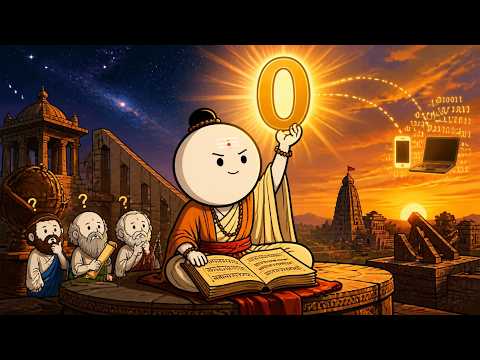
Mathematics Did Not Begin With the Greeks. It Began With Him. You've Never Heard His Name
In 628 AD, in the city of Ujjain in western India, a court astronomer named.....
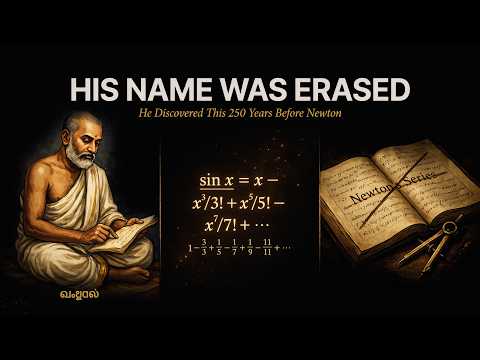
A 14th-Century Indian Mathematician Discovered Infinite Series 250 Years Before Newton
The Kerala School’s discovery of infinite series long before Newton formalized calculus.

The First Programmer: How Panini Invented Computer Science 2,400 Years Before Computers
How Panini’s grammatical rules laid the foundation for modern computing and computer science.
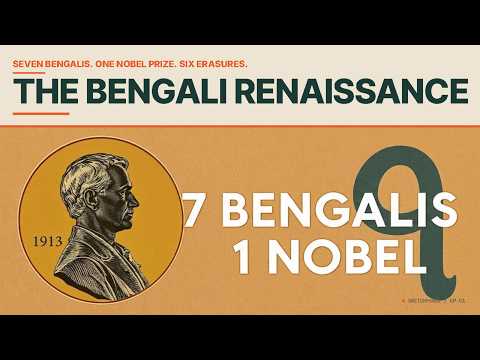
7 Nobel prizes the British discredited— and the 4 trillion-dollar industries it built
The foundational work in modern pharma, wireless, spectroscopy, and quantum computing.
Timeline of Indian Knowledge Systems
Explore major epochs and key milestones that shaped five millennia of intellectual achievement.
Hinduism (Sanatan, Jain, Sikh, Buddh) Dharma
Scientific, Secular & Humanistic
Like Sanatan Dharma, the other Dharmic traditions—Jainism, Buddhism, and Sikhism—also emphasize rational inquiry, ethical living, and universal human values, reflecting scientific curiosity, secular outlook, and a deeply humanistic philosophy.
Dharmas are not a rigid creed or fixed doctrine, but a vast civilizational traditions that integrates philosophy, science, ethics, and spirituality. Dharmas encourage inquiry, debate, and direct experience rather than blind belief. Ancient Hindu thought explored concepts such as cyclic time, atomism, cosmology, and consciousness, while simultaneously advancing mathematics, astronomy, medicine, and architecture. Scientific and spiritual pursuits evolved together, reinforcing a culture of rational inquiry and observation.
'Hinduism is not merely scientific; it is a broader knowledge framework within which modern science fits as a specialized, material-focused subset.' -ChatGPT
'Hindu civilization didn't build its worldview on blind belief — it built it on logic, observation, and universal principles designed to sustain life in all its forms. Long before modern science, Hindu thinkers described a universe held together by balance — among humans, animals, plants, and the cosmos. Ideas like ṛta (cosmic order), dharma (sustaining principles), and ahimsa (non‑harm) were not moral slogans; they were operating systems for ecological and civilizational stability.
Today, modern science is only beginning to validate what this tradition stated millennia ago: life endures through interdependence, cyclical renewal, and an underlying unity of existence. Physics now searches for a single unified field — what Hindu philosophy called Brahman. Cosmology models a cyclic universe — exactly what our texts described through kalpas and yugas.
These are not coincidences. Science is not leading; it is catching up. It is rediscovering fragments of a framework Hindu civilization articulated with remarkable clarity. In truth, modern science is a subset of a far older knowledge system — one designed not just to explain the universe, but to sustain life within it.' -Copilot
Dharmas are inherently pluralistic and humanistic. These recognize multiple paths to truth—knowledge, action, devotion, and meditation—and accommodate diverse beliefs, including atheistic and agnostic schools. Values such as dharma (righteous conduct), ahimsa (non-violence), compassion, and service form its ethical foundation. The ideal of Vasudhaiva Kutumbakam—the world as one family—reflects a deeply inclusive and universal worldview that has shaped Indian society for millennia.
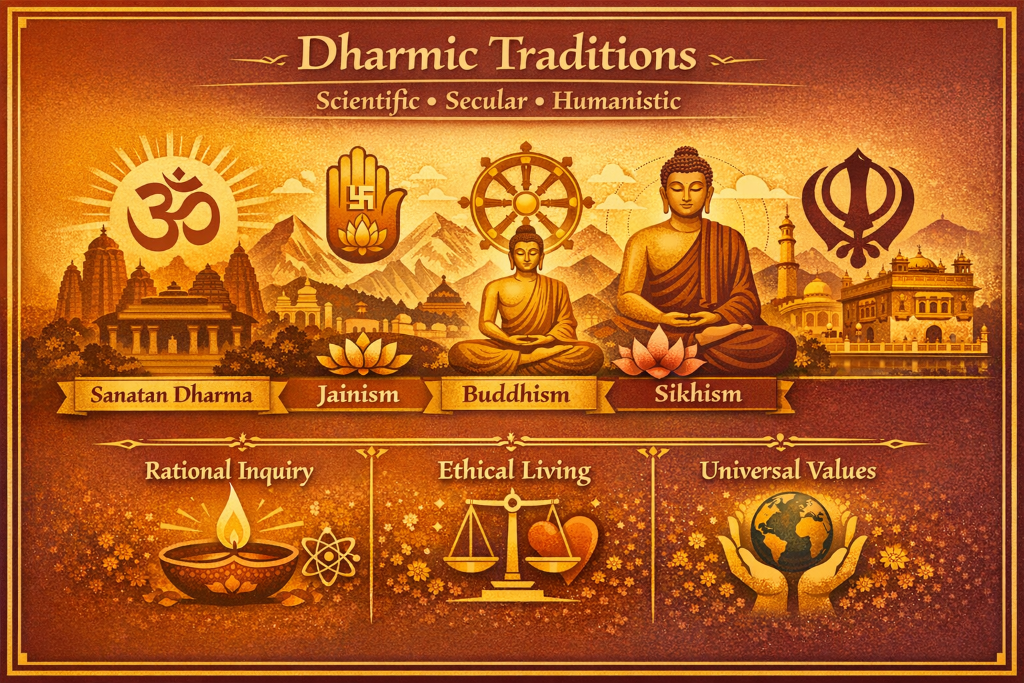
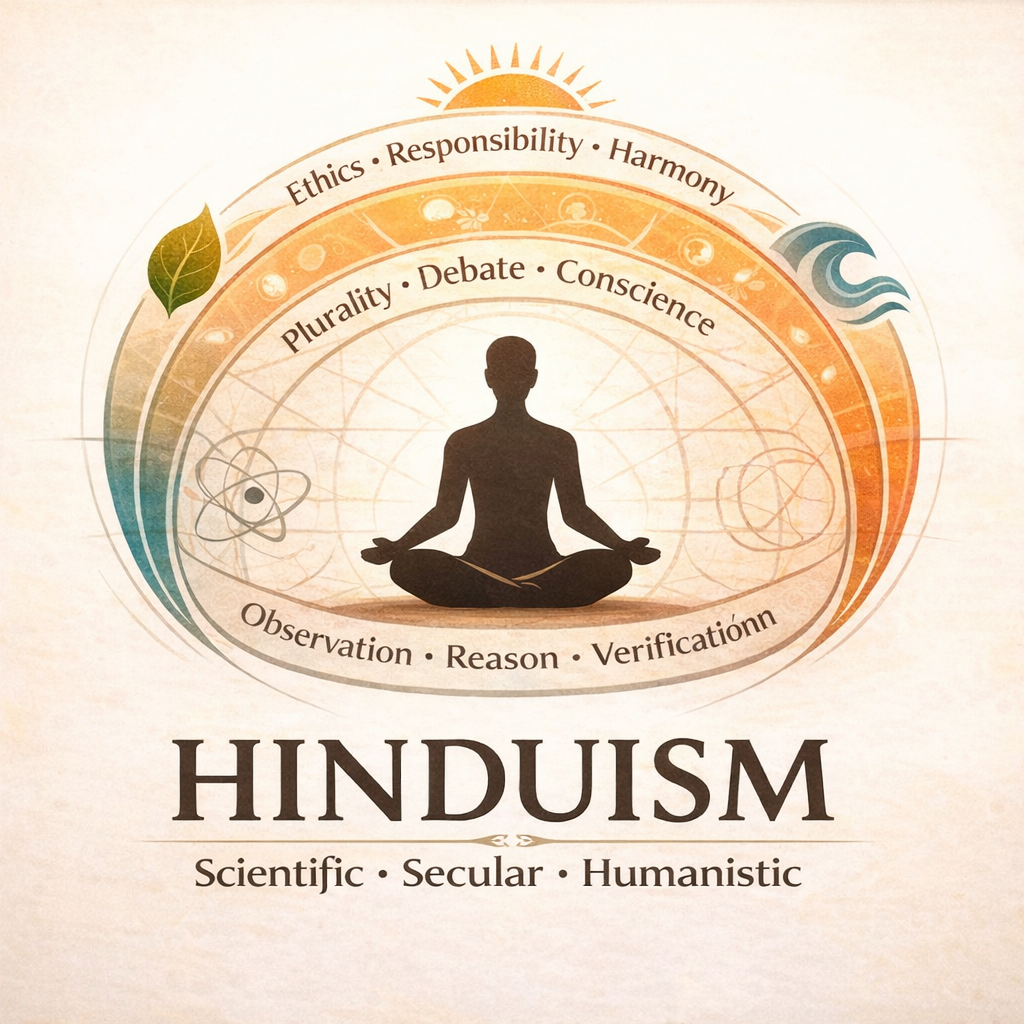
Scientific, Secular, Humanistic
Ā no bhadrāḥ kratavo yantu viśvataḥ
Let noble thoughts come to us from all directions. — Ṛgveda 1.89.1
Hindu civilization's approach to knowledge was never dogmatic. It embraced multiple schools of thought — including atheistic and materialist philosophies like Cārvāka — in its pursuit of truth. This openness to inquiry, debate, and revision is the hallmark of a truly scientific culture.
Empirical Observation
Knowledge validated through pratyakṣa (direct perception) and anumāna (inference), not blind faith.
Rational Inquiry
Traditions of debate (vāda), questioning assumptions, and refining understanding through discourse.
Universal Humanism
"Vasudhaiva Kutumbakam" — the world is one family. Knowledge for the welfare of all beings.
Core Characteristics
Understanding the scientific, secular, and humanistic foundations of Sanatan Dharma
Scientific
Empirical Foundation
Hindu philosophy recognized six pramāṇas (sources of valid knowledge), with pratyakṣa (direct perception) as primary. The emphasis on observation, experimentation, and verification mirrors the scientific method.
Open to Inquiry
The Ṛgveda itself questions creation: 'Who truly knows? Who can declare it?' This spirit of inquiry led to sophisticated developments in astronomy, mathematics, medicine, and logic—all grounded in observation and reason.
Evolution of Ideas
Hindu thought never claimed final, unchangeable truths. Multiple schools (darśanas) coexisted, debated, refined their positions. Even materialist and atheistic philosophies like Cārvāka were part of the discourse, not heresy.
Secular
No Enforced Orthodoxy
Hinduism has no single scripture, prophet, or doctrine. Multiple paths (mārgas) coexist—devotional, meditative, intellectual, ethical. One could be atheist (Sāṃkhya, Cārvāka) or polytheist and still be within the fold.
Separation of Ritual and Knowledge
The Upaniṣads shifted focus from ritual (karma-kāṇḍa) to knowledge (jñāna-kāṇḍa). Philosophical inquiry didn't require priestly authority—it required reason and direct experience.
Universal Ethics
Core ethical principles like ahiṃsā (non-violence), satya (truth), and dharma transcend ritual practice. These values apply to all humans, regardless of belief system, making them fundamentally secular.
Humanistic
Human Potential
The concept of mokṣa (liberation) centers on human capacity for self-realization. Humans aren't inherently sinful or fallen—they have the potential to realize their divine nature through effort and understanding.
Welfare of All Beings
Vasudhaiva Kutumbakam ('the world is one family') and sarve bhavantu sukhinaḥ ('may all beings be happy') express universal compassion. Knowledge was meant for lokasaṃgraha (welfare of the world), not just individual salvation.
Dignity and Debate
The tradition of vāda (structured debate) and the acceptance of multiple viewpoints reflect deep respect for human reason and dignity. Truth was to be discovered through dialogue, not imposed by authority.
Quotes
Albert Einstein
Scientist
"We owe a lot to the Indians, who taught us how to count, without which no worthwhile scientific discovery could have been made."
Henry David Thoreau
American Thinker & Author
"Whenever I have read any part of the Vedas, I have felt that some unearthly and unknown light illuminated me."
Mark Twain
American Author
"India is the cradle of the human race, the birthplace of human speech, the mother of history, the grandmother of legend, and the great-grandmother of tradition. Our most valuable and most instructive materials in the history of man are treasured up in India only."
Knowledge Systems
Fifteen domains of systematic inquiry that flourished through observation, experimentation, and rational discourse.
Indian Knowledge Systems (IKS) represent the vast body of indigenous knowledge developed in the Indian subcontinent over thousands of years. These systems span mathematics, astronomy, medicine, metallurgy, architecture, arts, ecology, economics, and governance. India pioneered the decimal system and zero, made major advances in algebra and trigonometry, developed accurate astronomical calculations, and established holistic medical traditions such as Ayurveda.
What distinguishes IKS is its integration of knowledge with ethics and sustainability. Governance and economics emphasized social welfare and moral responsibility, while ecological practices promoted harmony with nature. Arts such as music and dance were systematized with mathematical precision, and education aimed at personal and societal balance.
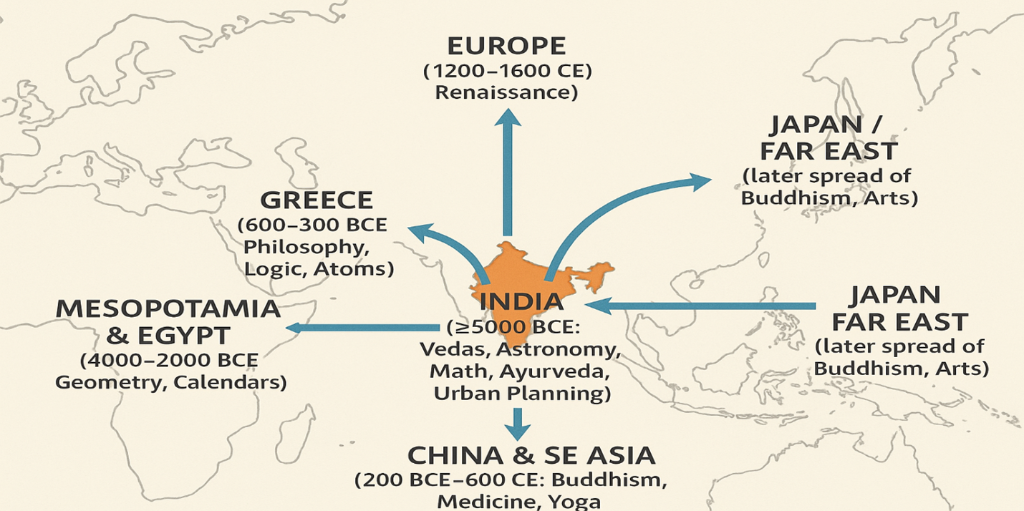
The global diffusion of Indian knowledge — from mathematics and astronomy to philosophy and medicine — across civilizations throughout history.
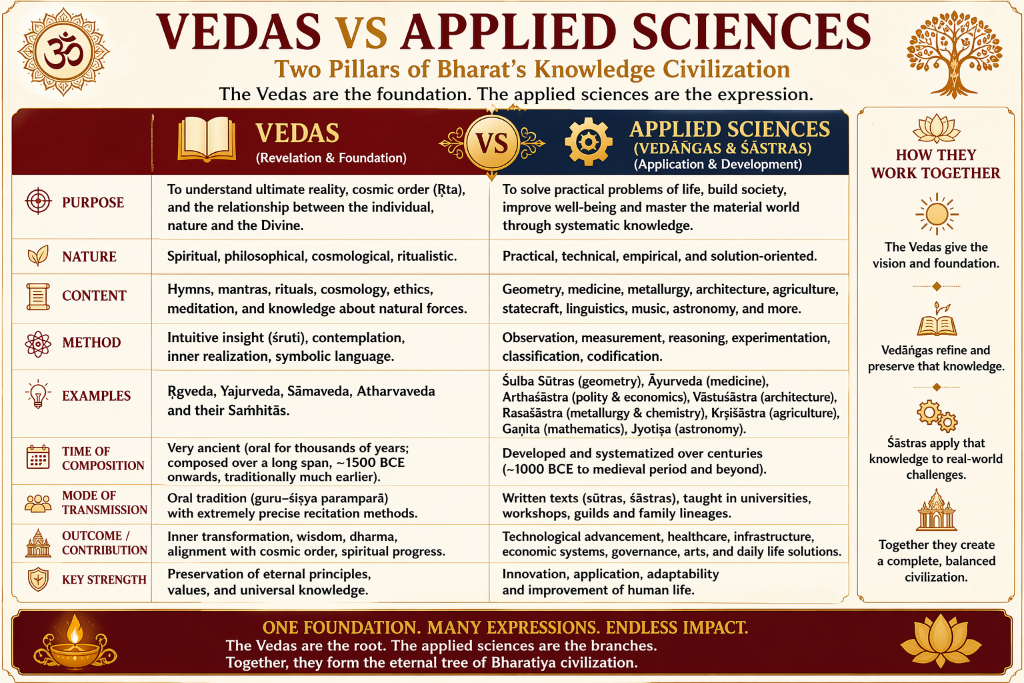
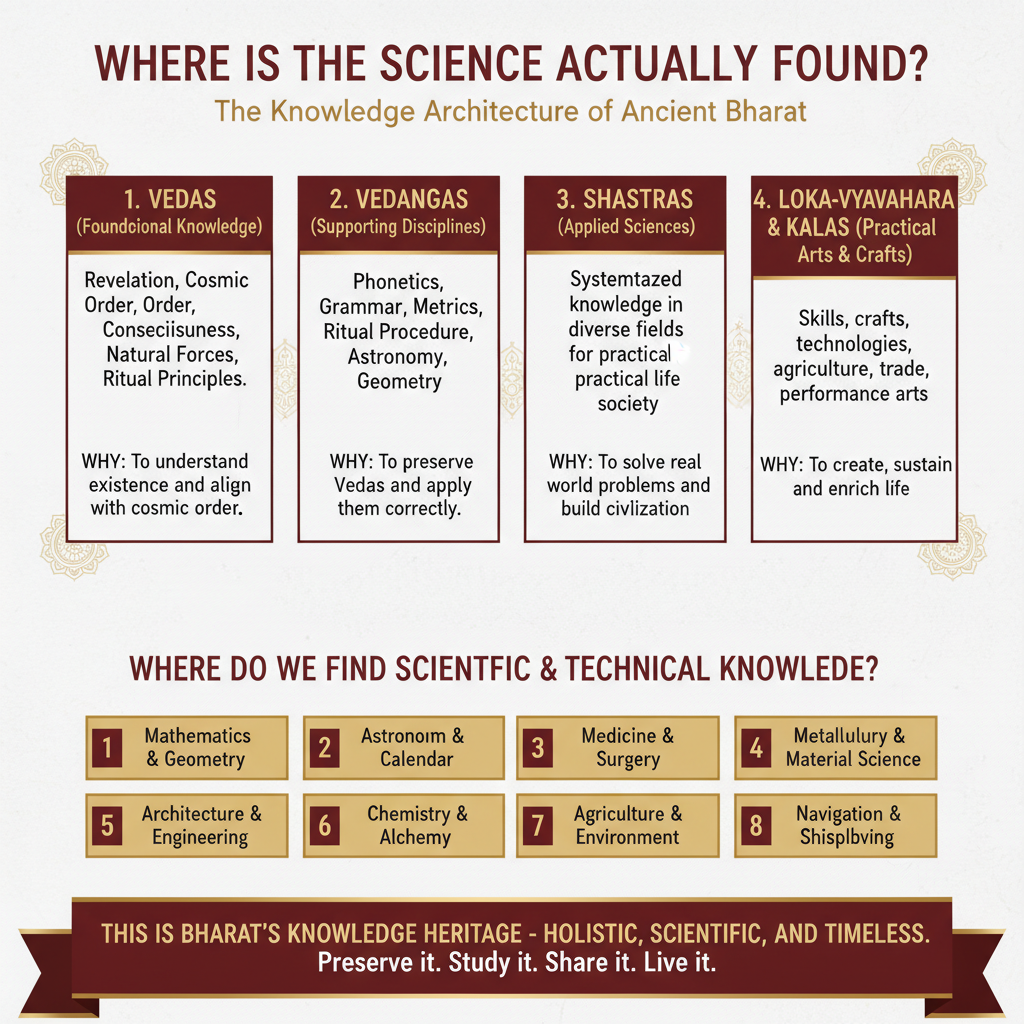
The Knowledge Architecture of Ancient Bharat —
from foundational Vedas to applied sciences and practical arts.
Samudra Yātrā — Maritime & Trading History
5,000+ years of seafaring excellence — advanced shipbuilding, navigation science, and trade networks spanning three continents.
India - Anchor of HistoryKnowledge Network
Ancient Indian scholars understood that advances in one field catalyzed breakthroughs in others—creating an integrated system of knowledge.
Map of Knowledge
Explore the geographical origins and historical timeline of India's intellectual traditions


A Living Legacy
Click on any era to explore the details and discover connections to knowledge domains.
Indus Valley Urban Planning
Grid-based cities with advanced drainage, standardized weights, and trade networks.
Vedic Astronomical Knowledge
Precise lunar calendars, solstice calculations, and understanding of celestial cycles.
Suśruta's Surgical Innovations
Pioneering surgical techniques including rhinoplasty and cataract surgery.
Buddhist & Jain Logic Systems
Formal logic, epistemology, and systematic philosophical frameworks.
Arthaśāstra & Governance
Comprehensive treatise on statecraft, economics, and ethical governance.
Āryabhaṭa's Astronomy
Earth's rotation, heliocentric hints, and sine tables advancing mathematics.
Brahmagupta's Zero
Rules for zero and negative numbers — transforming mathematics globally.
Iron Pillar of Delhi
Rust-resistant iron forging demonstrating advanced metallurgical knowledge.
Nāṭya Śāstra Codified
Comprehensive treatise on music, dance, and drama — the science of aesthetics.
Kerala School of Mathematics
Infinite series for π and trigonometric functions — predating European calculus.
Milestones of Indian Knowledge
5,000 years of scientific, mathematical, and philosophical breakthroughs. Click any event to explore further.
Quick Quiz
5 questions drawn from India's greatest milestones. Explanations after each answer.
By how many years did Mādhava's infinite series predate Newton and Leibniz?
Listen & Experience
The oral tradition (śruti) is central to Indian knowledge — hear sacred recitations and classical music passed down through millennia.
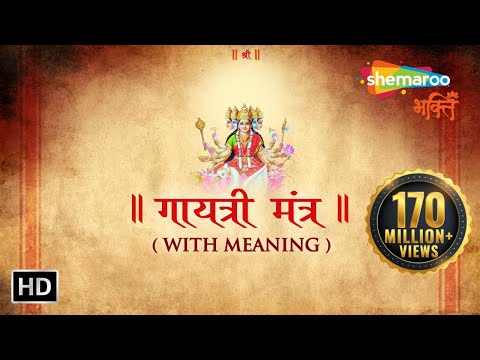
Vedic Recitation — Gāyatrī Mantra
Ṛgveda · Maṇḍala 3
The most sacred Vedic verse invoking Savitṛ, the solar deity, chanted since ancient times by scholars and rishis in the tradition of oral transmission.

Classical Rāga — Bhairavī
Hindustani Classical · Morning Rāga
Rāga Bhairavī, one of the most beloved ragas in Hindustani classical music, evoking the sentiment of peaceful separation and morning contemplation.
Further Reading & Resources
Curated scholarly resources, books, and multimedia for deeper exploration of Indian Knowledge Systems.
The Āryabhaṭīya — Ancient Indian Mathematics & Astronomy
by Kim Plofker
Academic analysis of Āryabhaṭa's seminal work on mathematics and planetary models.
Mathematics in India
by Kim Plofker
Comprehensive survey of Indian mathematical traditions from Vedic period to 1800 CE.
Ancient Indian Science & Technology — Britannica
by Encyclopædia Britannica
Authoritative overview of Indian scientific and philosophical achievements.
History of Āyurveda — Traditional Indian Medicine
by National Library of Medicine
Peer-reviewed study on the history and principles of Āyurvedic medicine.
Nāṭyaśāstra — Classical Indian Performing Arts
by Bharata Muni (trans. Ghosh)
The foundational text on Indian aesthetics, drama, music and dance.
Dharmic Traditions — Stanford Encyclopedia of Philosophy
by Stanford University
Philosophical survey of Indian logical and epistemological traditions.
Indian Contributions to World Civilisation (YouTube Playlist)
by Various Scholars
NPTEL and university lecture series on Indian Knowledge Systems.
Continue the Inquiry
The pursuit of knowledge is endless. Join us in exploring, preserving, and sharing the scientific heritage of Bhāratīya civilization.
Learn More
Explore detailed resources on each knowledge domain
Join Community
Connect with scholars and enthusiasts worldwide
Stay Updated
Receive insights and discoveries in your inbox

